Tag: manta rays

  • Komodo National Park

    Komodo National Park

    Last year Dom and I had the opportunity to work in Komodo National Park. It is a stunning place, the best place I worked so far.

    KOMODO NATIONAL PARK

    The 29 mostly uninhabited volcanic islands of Komodo National Park present a very dramatic landscape. It is a pleasure for the eyes. Savannah and sporadic trees cover the tall rugged hillsides.  The hills drop down to the strikingly white beaches contrasting with the surrounding green mangroves.

    Komodo National Park lies off Flores Island, between the provinces of East Nusa Tenggara and West Nusa Tenggara. The dry climate and lack of rain for most of the year make cause this area to be much more rugged compared with the rest of Indonesia.

    Komodo, Scuba Diving

    This area is nicknamed “the dry tropics”. From April to November, the rainfall is almost non-existent. This particular climate makes for totally unique settings.

    Apart from a few fishing villages and communities, the Komodo Dragons are the most notorious inhabitants of the National Park. They are found on the two larger islands, Komodo and Rinca. Every year, a large number of intrepid tourists from all over the world is attracted by these aggressive and rather ugly huge lizards. As a fact, they are the largest lizards in the world.

    The National Park was founded in 1980, initially to protect the Dragons. Later on the Government. also aimed to protect the abundant marine life by forbidding fishing within the Park. In 1991 Komodo National Park became a UNESCO World Heritage.

    Komodo, Scuba Diving

    SCUBA DIVING

    Nowadays, scuba diving is considered the main tourist attraction of Komodo National Park. Dive shops are literally growing overnight in Labuan Bajo. Komodo is home to some of the best scuba diving in the world. It offers many different dive sites and an abundance of marine life that is not common in any other area.

    Many of the dive sites can be dived on day trips. Others are too far and can only be dived from liveaboards. Many species can be seen. From Sharks to Mantas to schooling Jacks, Barracudas, Sweetlips, Batfish and tiny critters just to name a few. There are many possible encounters when scuba diving in Komodo.

    Komodo, Scuba Diving

    DIVING CONDITIONS

    The conditions in Komodo can be very extreme and challenging. Some of the dive sites are not suitable for beginners or inexperienced divers due to the very strong currents. However, strong currents are what make the marine life here so unique.

    Soft corals have a close relationship with strong currents, for they need this environment to grow. Big fish love strong currents too. It is their favourite playground. If there were no strong currents Komodo National Park would not be what it is!

    Komodo, Scuba Diving

    Strong currents here are due to two factors. A rather shallow sea bottom (maximum depth reaches approximately 90 mt.) and the position of Komodo and Rinca islands create a long narrow channel between them. These two agents cause strong tidal currents, for there is a great amount of water channelled through this small passage at falling and rising tides. Of course, they are not strong all the time. Sometimes you might go to a dive site and find ripping washing machine currents, then go back another day to the same site and there will be no currents!

    Some dives can be an adrenaline burst full of excitement. It needs to be said that sharks and Mantas are huge fans of strong currents. Komodo is blessed with good visibility most of the time.

    Komodo, Scuba Diving

    DIVE SITES

    The many dive sites are located in the North, Middle and South of the National Park. The South area is mainly dived by liveaboards due to the long distance from the mainland. However, the best dive sites are located in the North and Middle and they are easily reachable on a day trip. Every dive site has something special to offer but some are more special than others.

    Komodo, Scuba Diving

    North:

    Crystal Rock, Castle Rock and Cauldron are not to be missed. They are all advanced dives due to strong currents. Big chances to encounter big fish! Giant Trevally, White Tip and Grey Reef Sharks and occasionally Mantas.

    Komodo, Scuba Diving

    Middle:

    Batu Bolong – advanced dive, on a lucky day you might spot the magnificent Napoleon Wrasse and White Tip Sharks.

    White Sands and Airstrip for Mantas, Tatawa Besar and Siaba Kecil for a fun-filled drift dive hovering above a pristine colourful coral garden, Waenilu for critters lovers. These are all dives suitable for beginners as well as experienced divers depending on the day conditions.

    Komodo, Scuba Diving

    WHEN TO VISIT

    We were in Komodo from June till the end of December. The conditions were good all the time. Mantas populate the waters from October to June.

    Visibility from March to November reaches 25-30+ meters. During the rainy season December to March, it can drop to 7-10 meters.

    Water temperatures range between 25-29C.

    The busiest months are July, August, October and November.

    Komodo, Scuba Diving

    HOW TO GET THERE AND WHERE TO STAY

    Labuan Bajo is the gateway to Komodo National Park.

    It is easily reachable with daily flights from Bali (Garuda airline, Lion Air and Wings Air).

    The town is in continuous growth and a new airport was opened in June 2014. Works are still going on at the airport to make it an international hub.

    The area is expecting a great number of tourists coming. Labuan Bajo offers a good choice of accommodations ranging from backpackers to high-end.

    Komodo, Scuba Diving

    For divers that want to enjoy more peace and experience exclusive Komodo, Angel Island is the perfect destination.

    Angel Island Resort on Pulau Bidadari

    There are two other private island resorts:

    Komodo Resort on Pulau Sebayur

    Komodo, Scuba Diving

    AIRLINES

    Garuda airline

    Lion Air and Wings Air

    Have you ever dived in Komodo? Share your experience in the comments if you did!

    Komodo, Scuba Diving

    Komodo, Scuba Diving

    Komodo, Scuba Diving

    Komodo, Scuba Diving

  • Komodo

    Komodo

    When Dom left, of course it was not the same! However, there was still a couple of places I wanted to visit before leaving in Indonesia so I ventured alone on the last leg of my trip.

    This last part of the journey was mainly for diving. I could not leave Indonesia without diving the amazing Komodo National Park and Lembeh.

    Since I had quite some time available, I decided to do the journey from Bali to Komodo overland and stop along the way.

    From Bali I caught the ferry to Gili Trawangan where I stopped a few days to catch up with a couple of friends. The second part of the journey was very long! I got from Gili Trawangan to Lombok by boat, then crossed Lombok by bus and caught another ferry to Sumbawa.

    I got back on the bus across Sumbawa and finally a last ferry to Labuan Bajo (longest ferry journey ever, 8 hours!). The whole trip took about 33 hours! I know it was a little crazy but at least I got to see the beautiful land.

    Labuan Bajo is the starting point for daily diving trips and liveaboards to Komodo National Park. I chose to dive with Dive Komodo, a dive operator that was recommended by friends.

    I decided not to do a liveaboard this time and just did 3 day trips, 3 dives each day.

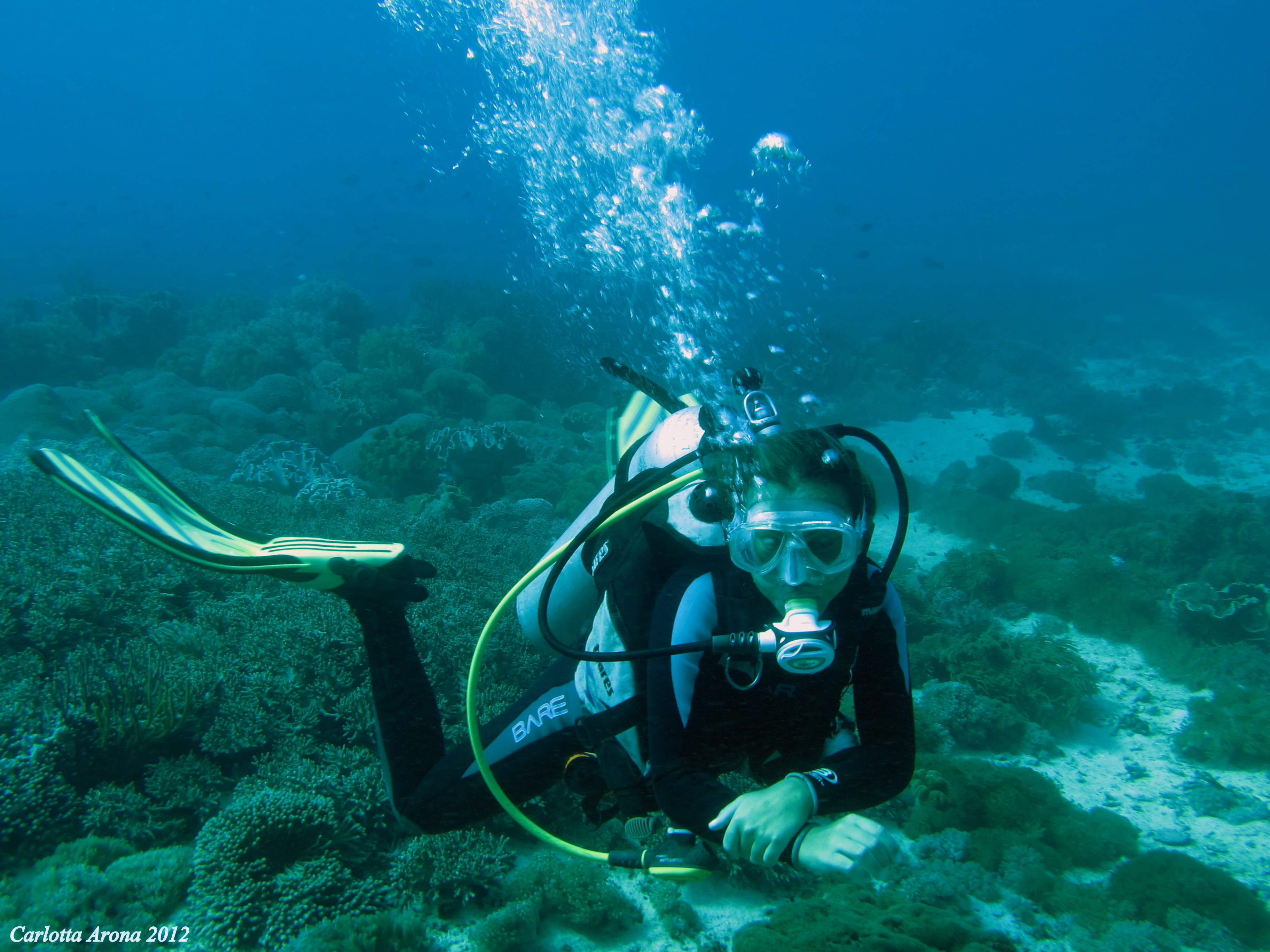
    It was absolutely fantastic and I was lucky to get to dive three of the best dive sites in the National Park: Castle Rock, Crystal Rock and The Cauldron. I saw Manta Rays, White Tip Sharks, Turtles, fantastic soft and hard corals and much more!


  • Did We Find Mantas in Nusa Lembongan?

    Did We Find Mantas in Nusa Lembongan?

    Nusa Lembongan is a very small island in the south of Bali. It can be easily reached by ferry from Sanur in only 30 minutes.

    After Tulamben we drove back to Sanur and the next day we headed to Lembongan.

    Reason why I wanted to go there, besides having heard it is a beautiful island perfect to chill out, was because until then I had never ever seen a Manta Ray!!

    There is a dive site close to the island called Manta Point and it is almost guaranteed to see a Manta Ray every dive. I was craving for seeing a Manta. I had only seen it in pictures and videos or heard stories from other divers. I always seemed not to be in the right place when Mantas were seen.

    I remember last year in Pulau Weh coming back from a dive, a group of divers saw five mantas and we didn’t even see the shadow of them! (and we were in the same dive site!).

    Dom was lucky to see a few when he was working on one of the liveaboards in Koh Lipe, now I wanted to see them. Or at least one. It was also still Mola Mola season (Sun Fish) and there was good chances to spot them here.

    After a short ferry ride we arrived in Nusa Lembongan and headed straight to Drift Divers, a dive shop that was recommended to us by a couple of diving instructors we met in Pulau Weh, and booked the dives for the next day.

    It was October and low season so there was not many divers around, but the owner of the dive shop agreed to take us to Manta Point and Crystal Bay (this one is the dive site for Mola Mola). Awesome all sorted!

    Now we needed accommodation which wasn’t difficult to find since a friend of the shop owner sorted us out with a room at a very cute resort on the beach called Linda Bungalows and a motorbike. We had a room at the top of the building with awesome views over the surf brake.

    Massive waves could be seen every day with brave surfers riding them. We learned later that that particular surf spot is called “Laceration Point”, only for the very experienced surfers.

    The beaches of Nusa Lembongan are being used as seaweed farms. The locals work hard to grow and harvest seaweed which is then sent to the main cities or exported internationally to make beauty and health products.

    The locals, mainly the elderly population, work very hard in the seaweed farms, all day long. If they are not harvesting with their feet in the water, they are sorting out the crops sitting under the hot sun.

    The next morning we woke up nice and early to join the dive trip. I was very excited but I tried not to expect too much since I might have been out of luck again.

    After about a 30 minutes boat ride we got to the dive site, Manta Point. Our guide told us we were going to stay shallow, max 10 meters and look for Mantas.

    We hit the water and descended. The water was quite refreshing, about 22C. It was the coldest I have ever been diving! Dom and I were wearing two wetsuits and it still felt quite chilling. After about 15 minutes into the dive one Manta passed over our heads.

    That was it, I thought. Finally I saw a Manta and I wasn’t as excited as I thought I would be (maybe I was disappointed cause it was only one and it passed by rather quickly!). Then another… and nothing else. I was almost disappointed now but then… I couldn’t believe my eyes! Six of them (I mean S I X!) all together came towards us and just danced and played on top of our heads for about twenty minutes!!

    That was absolutely magical, awesome and almost unreal. I was there, at last, with these beautiful creatures. It was overwhelming and I was so happy I could experience it with Dom. There we were Dom, I, another diver, our guide and six Mantas. An exclusive treat, I’d say. I was happy.

    When we ended the dive and went back to the surface, we noticed at least another five boats but none of the divers saw the Mantas. That was a lucky dip!

    We headed to Crystal Bay and half hour into the dive we spotted a Mola Mola. Unfortunately it was quite far away, but at least we saw it. It was an amazing lucky day! We didn’t do any more dives afterwards. We were happy to have seen what we had come to see.

    We spent the following days chilling out, exploring and drinking cold Bintang. We stayed in Lembongan for a week and then headed back to Bali. Dom had to catch a plane to get back to New Zealand and I was going to travel Indonesia for another month and a half before joining him in his Country.